There Is No Spoon, and Your Brain Knew It First: Deviate by Beau Lotto
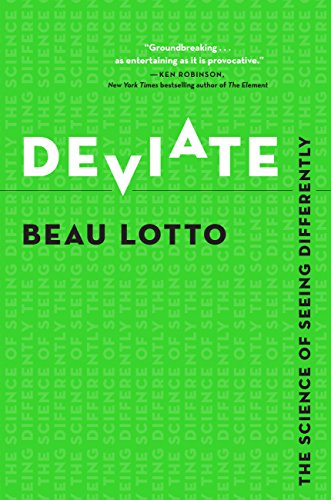
Cover shown for review. As an Amazon Associate, Coach Kev earns from qualifying purchases.
There is a sentence in Beau Lotto's Deviate that I quote constantly, and it is this: your brain did not evolve to see the world accurately, it evolved to keep you alive, and those two jobs are not the same. Lotto is a neuroscientist who has spent his career on perception, on optical illusions and color and the machinery of how we see, and the whole book builds toward one unsettling, liberating idea, that you never actually experience reality, you experience your brain's best guess about it.
Start with the eyes, because that is where he starts, and because it is impossible to argue with. The light that hits your retina is meaningless on its own, a flat wash of wavelengths with no built-in labels, no depth, no objects, nothing that tells you what any of it is or what to do about it. Your brain takes that meaningless input and, in a few milliseconds, constructs a full three-dimensional world of things that matter and things that do not, and it does this not by measuring reality directly, which it cannot do, but by comparing the input against every similar moment you have ever had and returning the interpretation that worked well for you before. You are not seeing what is there. You are seeing what was useful before. That is why optical illusions work on all of us identically, they are not tricks of the eye, they are your brain confidently showing you its assumptions.
Now take that same machinery and point it at everything else, because your brain does not run one process for color and a different, wiser process for meaning. The exact same predictive engine that decides what a patch of light is also decides what your boss's short reply means, what the silence after your text means, what your own failure last year means about your future. It does not calmly assess these things from neutral. It reaches into your history, pulls an interpretation that worked well the last time something looked like this, and hands it to you already finished, already emotional, and it does all of that before your conscious mind ever gets a vote. You think you are responding to what happened. You are responding to your brain's fastest guess about what it means, built from everything that came before.
This is what The Matrix was gesturing at with the boy bending the spoon, telling Neo there is no spoon, and it is easy to file that under mystical and move on. Lotto's contribution is that he takes the exact same claim and grounds it in hard perceptual science, which is why it belongs at the center of what I call Data-Driven Zen. The limits you experience as simply real, the meaning you experience as simply obvious, are constructions, assembled by a system optimizing for your survival in a past that is already gone. There is no spoon, and the reason there is no spoon is not spiritual, it is neurological, and your brain has known it your whole life.
Here is why this matters for the actual pain people carry, the guilt and the self-doubt and the anxious forecasting, because this could stay a fun fact about illusions and never touch anything. The story causing your suffering, whatever it is, that you are behind, that you are not enough, that the mistake defines you, that the silence means the worst, that story does not feel like a story. It feels like seeing. It arrives with the same automatic certainty as the color of a wall, which is exactly why it is so hard to argue with and so easy to obey. But if meaning is a prediction, and Lotto's whole career says it is, then the story is not a fact you are stuck with, it is your brain's best guess given your history, and a guess, unlike a fact, is something you are allowed to question and eventually retrain.
Lotto is careful, and I want to be too, because this is where people either cheapen the idea or overreach it. Knowing your perception is a construction does not let you see anything you want, you cannot decide the wall is a different color and make it so, and you cannot positive-think a real problem out of existence. That is not what this is. What it does is open a gap, a small deliberate space between the automatic meaning your brain hands you and the meaning you choose to act on, and in that gap is the only freedom any of us actually get. Lotto calls the skill deviation, the deliberate act of questioning the assumption your brain is treating as truth, and he makes the case that this is the root of all creativity, all adaptation, all seeing anew, because you cannot see differently until you first doubt the thing you are already seeing.
So here is the rep, and it is small on purpose. The next time you feel a strong, certain, painful interpretation snap into place, the text that obviously means they are done with you, the mistake that obviously means you are a fraud, catch it at the moment it arrives and label it out loud in your head: that is a prediction. Not the truth, a prediction, my brain's fastest guess built from before. Then ask one question of it, what is one other reading of this that would also fit the facts I actually have. You are not trying to force a happier story, forced positivity is just a different illusion, you are trying to prove to yourself that more than one reading fits, because the moment you genuinely see that two interpretations fit the same facts, the first one loses its grip as the only truth, and that loosening is the whole opening.
Do that enough times and something structural changes, you stop experiencing your first interpretation as reality and start experiencing it as a draft, and a draft is a thing you can edit. It will not be clean, the old automatic reading will keep arriving first for a long time, because it is fast and it is practiced and rewiring is never a straight line, but every time you catch it and label it as a guess, you widen the gap a little, and the gap is where you live once you know it is there.
Deviate is an extremely quietly radical book, a strange and rigorous read on how seeing actually works, and if you want the full science under the reframe you can find it here: https://www.amazon.com/dp/0316300195?tag=cklu-ionos-20. Read it and you will not be able to unsee the fact that you have been constructing your world all along, which is unsettling for about a week and then becomes an extremely useful thing to know, because a world you construct is a world you have some say in.